



In this Article
- What inspired you to become a physician?
- How did you choose pulmonary and critical care?
- What qualities define a good mentor?
- Your career path has evolved significantly, completing training that many do not have. What do you enjoy most now?
- What might surprise people about you?
- What is unique about Baylor Scott & White that has kept you within the system for 30 years?
- What grounds you outside of medicine?
Pulmonary medicine, hospice and palliative medicine
In this Article
- What inspired you to become a physician?
- How did you choose pulmonary and critical care?
- What qualities define a good mentor?
- Your career path has evolved significantly, completing training that many do not have. What do you enjoy most now?
- What might surprise people about you?
- What is unique about Baylor Scott & White that has kept you within the system for 30 years?
- What grounds you outside of medicine?
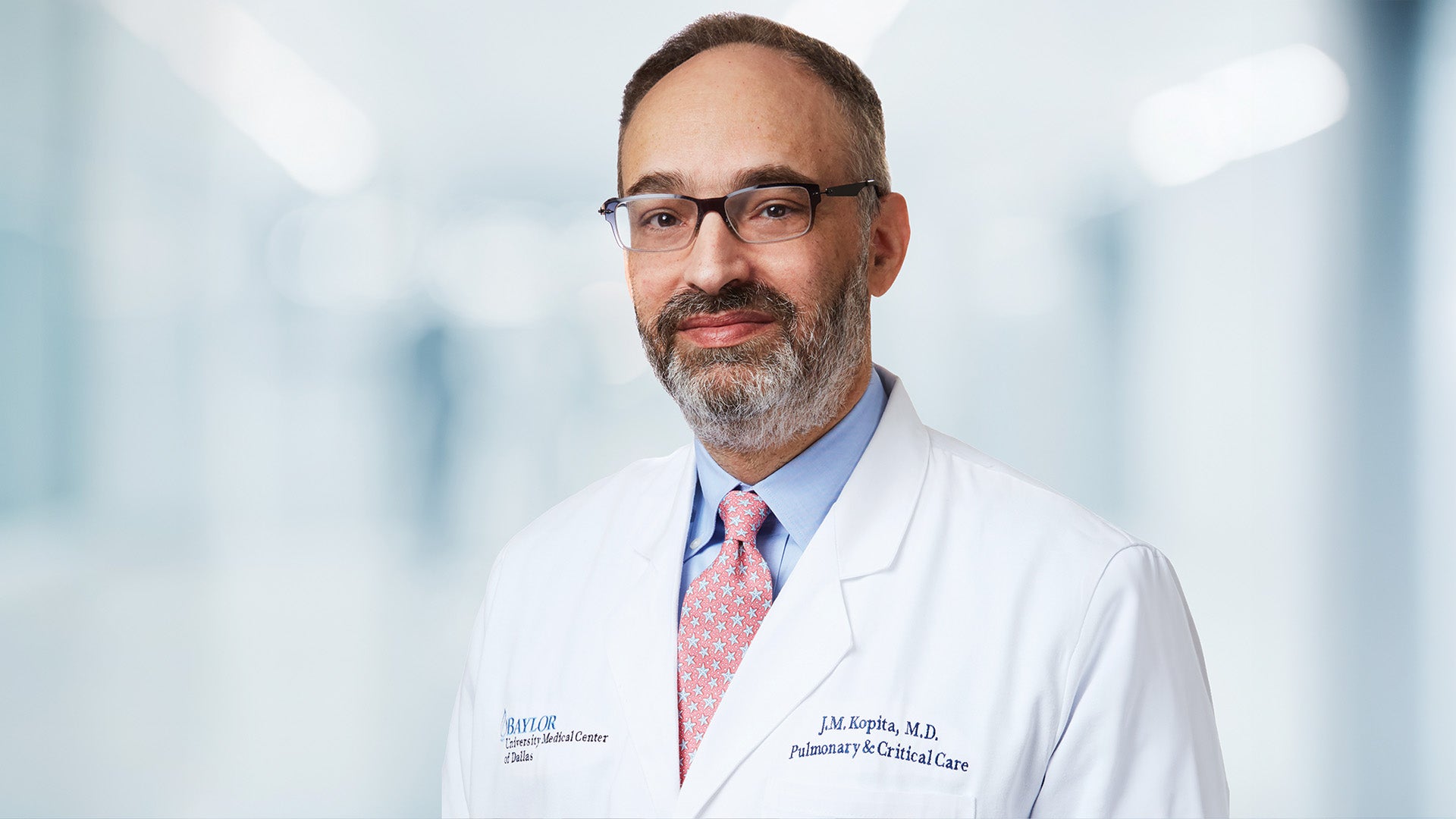
Jeffrey Kopita, MD, a pulmonologist at Baylor University Medical Center (BUMC), is board-certified in pulmonary disease and hospice and palliative medicine—a rare combination that places him among the few pulmonologists nationwide with dual certification. A graduate of the Medical College of Ohio at Toledo, he completed his internship, residency and fellowship at Duke University Medical Center, where mentors profoundly shaped his life and career.
After nearly 37 years in medicine, Dr. Kopita’s impact extends well beyond the bedside. A recent $2.5 million gift from a grateful patient family established an endowed chair to fund education and research at Baylor University Medical Center, honoring his commitment to education and compassionate care.
What inspired you to become a physician?
I decided at a young age. I was always interested in science, and growing up in Atlanta we had a wonderful family pediatrician. Dr. Williams became a mentor and encouraged me. I knew medicine was where I wanted to be.
How did you choose pulmonary and critical care?
In medical school, I thought I’d go into pediatrics. I loved the kids. But during my final required rotation in internal medicine at the Medical College of Ohio, I realized how broad and intellectually interesting internal medicine was.
In my internal medicine residency at Duke, I did cardiology, hematology-oncology and general medical rotations. Then, I ended up with the head of the pulmonary division, who was a wonderful teacher. Several mentors thought I would be great in a fast-track position in pulmonary and critical care.
This was a pretty smart bunch who take care of the sickest of the sick. This specialty tends to be “physician’s physicians.” I ultimately pursued a pulmonology and critical care fellowship, guided by physician mentors who were exceptional teachers.
Mentors changed everything for me. They also sparked my interest in medical ethics and end-of-life care, which led me to become board-certified in hospice and palliative medicine in 2012. It all boils down to who teaches you, and how they teach you to care for people.
What qualities define a good mentor?
Key qualities for an exceptional mentor include clinical excellence, effective teaching skills and a supportive, approachable attitude. A mentor demonstrates ethical, high-quality and compassionate care, as well as a commitment to life-long learning.
Your career path has evolved significantly, completing training that many do not have. What do you enjoy most now?
Pulmonary medicine allows flexibility. Early in my career, I did everything—critical care, administration and even served as a chief medical officer. When I stepped away from ICU work in my mid-50s, I built a general outpatient pulmonary program at Baylor University Medical Center and began teaching outpatient pulmonology to fellows. What started small has grown to eight physicians, two nurse practitioners and 16 team–members.
I love the outpatient setting. Evaluating shortness of breath, chronic cough and palliative needs makes the work broad, personal and deeply meaningful.
What might surprise people about you?

That the photography in my exam rooms is mine. I’ve been taking pictures since I was
11, starting with a Brownie camera as a Boy Scout. Nature, travel—especially
Ireland—are my passions. Some of my work is also displayed in the physicians’ dining
room.
Photography, like palliative care, is about peace. Images can bring calm to someone
who is suffering.
My wife, Alisone, and I are working on a project combining my photographs with the 23rd Psalm for patients facing serious illness.
I am also involved in Baylor Scott & White’s Arts in Medicine program. I have donated
four prints from Kauai to be displayed in Roberts Tower, once its renovated.
What is unique about Baylor Scott & White that has kept you within the system for 30 years?
Baylor Scott & White provides a high-quality health care system with a strong commitment to patient care and clinical excellence. During my time here, I have had the opportunity to serve in multiple roles, including clinical practice, administration, leadership and teaching—opportunities that allowed me to grow both professionally and personally. Additionally, I was fortunate to work with outstanding mentors here who played a significant role in shaping my development and career.
What grounds you outside of medicine?
Alisone and I met during my intern year at Duke and married in 1993. She’s a dietitian. Our daughter, Lilly, is an ER nurse pursuing her acute-care nurse practitioner certification, and our son, Phillip, works in cybersecurity.
Faith, family, music, history, good food—they all matter. I view every patient as family, regardless of background. Medicine isn’t just physical. Pain can be spiritual, existential. Caring for the whole person is the privilege of this profession.
For more information, contact