



The room was quiet.
A young man in his twenties lay surrounded by family on what would be his final day. He had battled leukemia for years. His doctor, Mark Casanova, MD, had walked with him through much of that journey.
Seated nearby was Terese Cullen, a certified music-thanatologist, her harp resting gently against her shoulder.
She began to play.
When music meets a sacred moment
Dr. Casanova, director of Clinical Ethics and Supportive Palliative Care at Baylor University Medical Center (BUMC), had seen Arts in Medicine practitioners in the hallways many times.
He often described their presence as “magical.” But this was different. This time, he was not just the physician in the room. He was also a recipient of the music.
“When you’re going in to see an established patient you’ve been with for years, and he’s dying, to have her playing there was just so magical,” he said. “Suddenly you, along with the family, are a recipient of that presence and that music.”
As he spoke softly with the patient and his mother, Terese adjusted her playing almost imperceptibly — allowing the music to soften beneath their conversation like a steady, peaceful current. When the room fell quiet again, she lifted the melody.
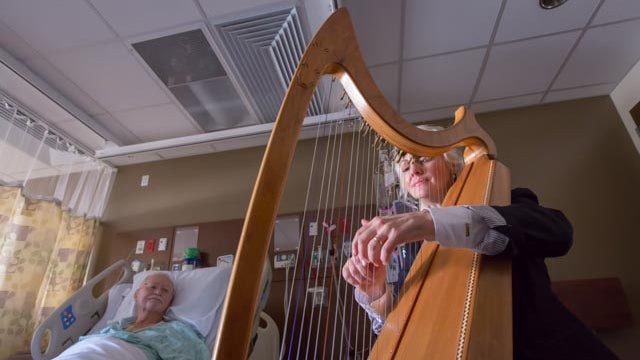
Her harp and voice followed the patient’s breathing and heartbeat, shaping each note to meet the moment exactly as it unfolded.
“Until you see it and you live it — and then you yourself are a recipient of that — it’s really hard to put into words the impact it had,” said Dr. Casanova, who also serves as assistant director for the Office of Clinical Ethics and Palliative Care at Baylor Scott & White Health.
What is music thanatology?
Music-thanatology is a specialized form of music care that blends clinical awareness with live harp and voice to support patients nearing the end of life.
At BUMC, this service is delivered by Terese, a certified music-thanatologist — one of fewer than 100 professionals in the nation and one of only two in Texas. Unlike background music or general performance, music-thanatology is prescriptive and responsive. Each note is shaped in real time to follow a patient’s breathing patterns, heart rate and emotional state.
Research suggests that hearing is one of the last senses to fade at the end of life. That understanding makes this work especially powerful. Even when patients can no longer respond outwardly, music may still offer comfort and grounding.
More than half of all music practitioner engagements now support hospice and palliative care — ensuring that patients and families navigating their final moments are met with presence, dignity and peace.
10 years of healing through the arts
In 2015, the Arts in Medicine program at Baylor Scott & White began supporting hospice and palliative care teams in moments just like this — when medicine has done all it can, but care continues.
What started as a single program has grown into a vital layer of compassionate support across Baylor University Medical Center and throughout the system.
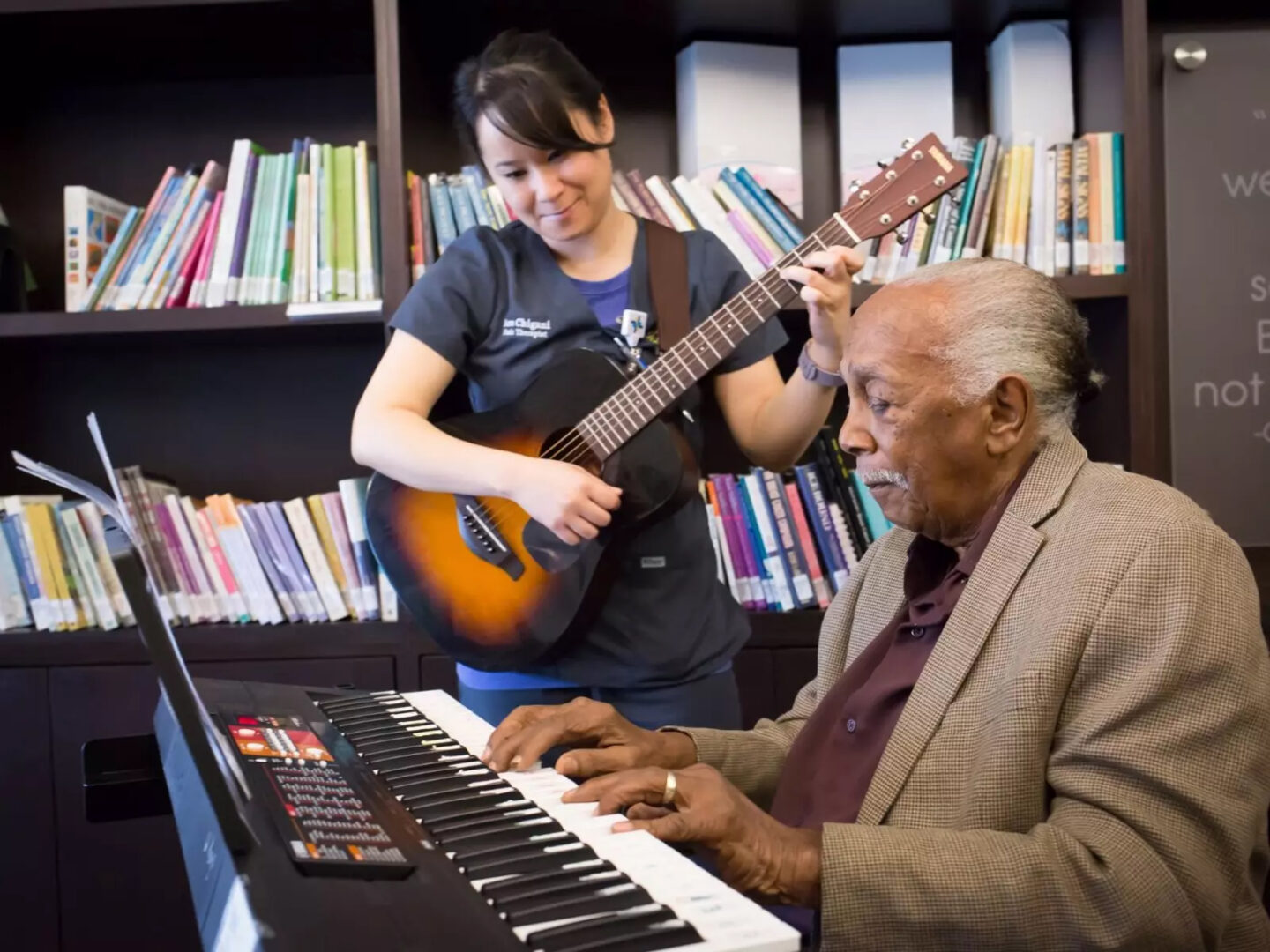
While this work is often referred to broadly as music therapy, the Arts in Medicine team provides specialized music care services, including music-thanatology at the bedside.
Since 2015:
- Music practitioners have conducted nearly 50,000 bedside sessions.
- In 2025 alone, the Arts in Medicine team provided nearly 1,000 sessions focused on end-of life, comfort care and hospice — representing more than half of all music practitioner engagements.
Behind every number is a family sitting vigil.
A physician carrying both clinical responsibility and emotional weight.
A patient whose final hours are shaped not only by treatment, but by tenderness.
Because of philanthropy, music-thanatology and bedside music are available when families need them most.
Elevating the spirit of care
End-of-life care is sacred work. It demands clinical excellence, emotional steadiness and deep humanity.
Arts in Medicine does not replace medical treatment. It elevates it.
“The Arts in Medicine program elevates the spirit of care across our institution,” Dr. Casanova said.
In rooms filled with uncertainty, music provides grounding. In moments heavy with grief, it offers gentleness. In final breaths, it brings dignity.
Philanthropic support ensures that this care remains woven into the hospital experience — not as an extra, but as an essential expression of compassion.
A legacy sustained by generosity
As Arts in Medicine marks its 10-year anniversary in 2026, its impact can be measured in tens of thousands of bedside sessions.
But its true legacy lives in quieter ways:
- In a family who feels less alone.
- In a physician who feels supported.
- In a patient whose final hours are wrapped in melody instead of silence.
Because of donors who believe healing reaches beyond medicine, moments of peace continue to unfold at the bedside — one harp string, one breath, one sacred pause at a time.
Every bedside session is made possible through donor generosity.
For more information, contact