



In this Article
- You’ve spent much of your career in academic medical centers practicing high-acuity medicine. What inspired your shift toward prevention and ultimately brought you to Baylor Scott & White?
- What does customer-centricity mean to you?
- How can philanthropy impact research?
- What keeps you up at night?
- What do you do outside of practicing medicine?
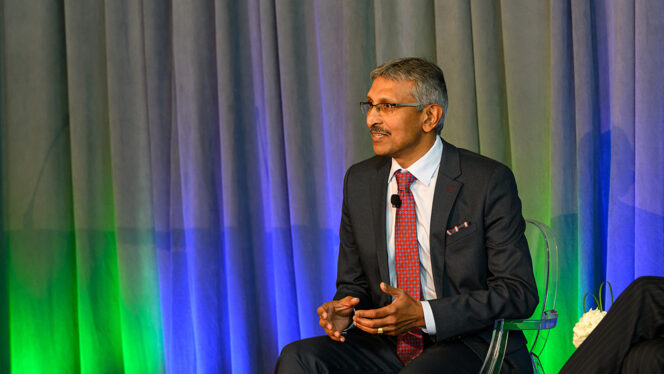
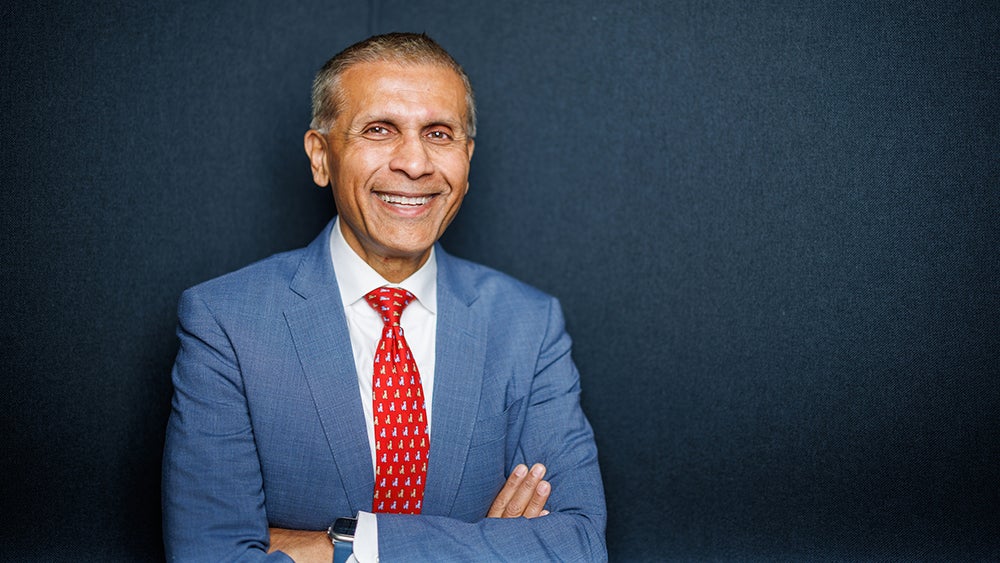
Dr. Javed Butler is the Maxwell A. and Gayle H. Clampitt Endowed Chair; President, Baylor Scott & White Research Institute; and Senior vice president, Baylor Scott & White Health
In this Article
- You’ve spent much of your career in academic medical centers practicing high-acuity medicine. What inspired your shift toward prevention and ultimately brought you to Baylor Scott & White?
- What does customer-centricity mean to you?
- How can philanthropy impact research?
- What keeps you up at night?
- What do you do outside of practicing medicine?
A leading authority in cardiovascular medicine and heart failure research, Dr. Javed Butler has built an international reputation as both scientist and strategist—bringing decades of experience from Yale, Vanderbilt, Harvard, Emory and beyond to his role as president of Baylor Scott & White Research Institute. His mission: to accelerate how new lifesaving therapies can be discovered and how, once discovered, these therapies move from clinical trials to everyday care.
Yet for all his academic and leadership credentials, Dr. Butler says his path to medicine wasn’t entirely his own idea.
“I wanted to be a theoretical physicist,” he said. “But my mother told me I needed to become a doctor. So here we are!”
Dr. Butler reflects on what drew him to Baylor Scott & White, the vision that guides his work and the values that inspire him.
You’ve spent much of your career in academic medical centers practicing high-acuity medicine. What inspired your shift toward prevention and ultimately brought you to Baylor Scott & White?
I was on one extreme of medical care. I never left the ICU. I began to realize that while we are doing these incredibly heroic medical interventions, many of them may simply not be needed if we focused on prevention. The entire healthcare system is focused on sickness, not prevention.
And serendipitously, someone called me about the position at Baylor Scott & White, and after visiting, I thought that if there’s anywhere you can advance prevention and evidence implementation, it’s BSW. It won’t be easy, but if any place can do it, this place can.
There are other health systems that are bigger, but once you cross state lines, you have to deal with different regulatory requirements. People have different electronic health records, and they don’t talk to each other. BSW serves one in 10 Texans, and everyone is on the same electronic health record. That makes it possible to identify opportunities, close care gaps and actually test what works in the real world.
What does customer-centricity mean to you?
One is the experience of care: how good is the experience when you come to Baylor Scott & White? You pick up the phone, you get appropriate help fast and in a kindly manner, you get an appointment and you receive care close to home. When you come in, the experience is good, your treatment goes well, and you go home as soon as possible.
Importantly, however, if you ask patients what they want from us, the number one thing they want is to have nothing to do with us. They want to live their lives outside the hospital, without diseases, without complications.
The only way you do that is by treating comorbidities better—managing blood pressure, cholesterol, diabetes, obesity, and screening for heart disease, kidney disease and cancer early, so people don’t develop diseases or disabilities in the first place.
With retail or air travel when you have a bad experience, you don’t remember the person’s name—you hold the store or airline responsible. In healthcare, we don’t think that way, but we need to.
Can we think about it in a more systematic, population-healthcare way—using the electronic health record and technology to tag high-risk patients, screen them, send reminders and do those things in ways acceptable to clinicians and at the same time make it easier for them and the patients? You may not measure prevention in an individual, but you can measure it in populations. That’s the biggest imperative, and that’s what I’m really focusing on.
How can philanthropy impact research?
Philanthropy is a cornerstone of research support in three areas. First is infrastructure—things like curating electronic health records, data platforms, computers or the cloud computing power needed to run large language models. Those are critical resources that will be near impossible to develop without philanthropic support.
The second is people, by helping us recruit luminaries and giving them the runway to establish their work.
And the third is preliminary data. Sometimes you need to study a handful of patients to show that an idea is feasible and safe before you can qualify for major funding.
Philanthropy builds the environment, brings in the talent and generates the first spark of evidence that allows us to go out and obtain larger grants.
What keeps you up at night?
Suffering. Human and animal. If you look around, there’s so much of it, and it’s worth that extra effort and doing whatever you can in small and big ways.
As Voltaire said, “Every man is guilty of all the good he did not do.” It’s not dark. It’s positive. How lucky we are that we can help people.
What do you do outside of practicing medicine?
Every single possible time that I have—driving, traveling, exercising—I’m listening to podcasts. But none are medicine. It’s either physics or philosophy.