



In this Article
- Kaylee, did you grow up knowing you wanted to be a nurse?
- You work in the oncology ICU today and help provide care for patients receiving bone marrow transplants. What drew you to oncology?
- After you were hired as a new nurse at Baylor Scott & White, you went through a graduate nurse residency. What was your experience in program?
- Speaking of making an impact, in addition to the education you receive, you also do research. What topic did you delve into?
- The graduate nurse residency is philanthropically funded. What message do you have for donors?
When a patient recovers faster, avoids complications or feels seen and heard during their most vulnerable moments, it’s often because a skilled nurse made the difference. At Baylor Scott & White Health, nurses do more than deliver expert and compassionate care — they help shape how patients heal, cope and move forward.
In this Article
- Kaylee, did you grow up knowing you wanted to be a nurse?
- You work in the oncology ICU today and help provide care for patients receiving bone marrow transplants. What drew you to oncology?
- After you were hired as a new nurse at Baylor Scott & White, you went through a graduate nurse residency. What was your experience in program?
- Speaking of making an impact, in addition to the education you receive, you also do research. What topic did you delve into?
- The graduate nurse residency is philanthropically funded. What message do you have for donors?
That’s why Baylor Scott & White invests in how nurses are trained, supported and developed from the very start of their careers.
With generous philanthropic support, the Baylor Scott & White Nursing Institute invests in the education, training and leadership development of nurses across the system. One of its cornerstone programs is the Graduate Nurse Residency, which supports new nurses through their first year in practice, building the skills and confidence required to care for patients independently.
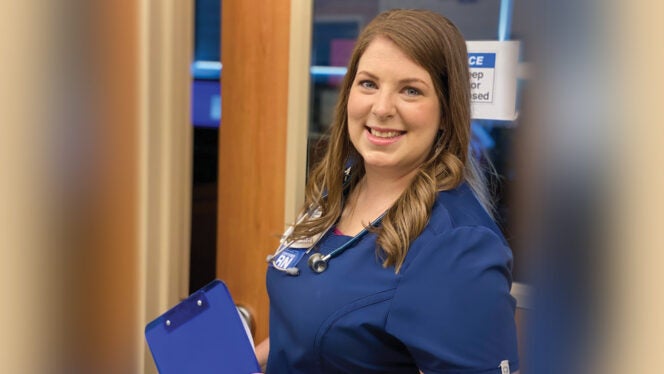
The Baylor Scott & White Dallas Foundation recently spoke with Kaylee Swaner, BSN, RN, a nurse caring for oncology patients at Baylor Scott & White T. Boone Pickens Cancer Hospital, about her experience in the Nurse Residency Program — and the impact she’s already having at the bedside.
Kaylee, did you grow up knowing you wanted to be a nurse?
It’s more God-driven than anything else. I was fortunate enough to not have family get sick or
need to be in the hospital when I was growing up. I played soccer at Oklahoma Baptist
University and originally thought I might go into occupational or physical therapy. Something
came over me and I decided to try nursing.
In December 2023, my dad got sick and ended up at Baylor Scott & White. I remember the way
the staff treated not only my dad, but also my mom and me. This was at Christmas, and it was a
difficult time to have a family member in the hospital – but we felt at ease with the care, and
appreciated the way we were being cared for emotionally and spiritually. I knew that I wanted
to be the light in a time of darkness for somebody.
You work in the oncology ICU today and help provide care for patients receiving bone marrow transplants. What drew you to oncology?
While I was in nursing school, I worked as a patient care technician on the floor I work on now.
After graduating with my bachelor’s in nursing, I knew I wanted to work here. I love the floor, I
love the people, I love what I do. Our patients can be with us for four to six weeks or more, and
I love the relationships I get to build with patients and their family members.
The culture here is all about selflessness. Everyone will put their day on hold to help each other.
After you were hired as a new nurse at Baylor Scott & White, you went through a graduate nurse residency. What was your experience in program?
Not every hospital system does something like this – in fact, I don’t know anyone else from my
nursing school who had a program like this in the hospitals where they began working. Here at
Baylor Scott & White, you have the benefit of this residency program integrated into your
whole first year.
Everyone in the program was so helpful. When I first got hired, my schedule was already made
for my first orientation and everything was laid out for me. The first month was really more
about the education to get you prepared to be on the floor. The next few months were learning
more about the unit and taking care of your patients. We had four-hour classes once a month
related to different topics, all of which allowed me to be more confident and knowledgeable in
my career.
Baylor Scott & White brought in experienced professionals to give us guidance. That was really
helpful because as a new grad and in oncology, there’s not just spiritual and cultural and
physical, there’s also the ethical topics. There are so many categories you hit. That was really
helpful to have that guidance within my first year. We can have better patient outcomes and
staff satisfaction, and we learned that we can make an impact, even as new grads.
Speaking of making an impact, in addition to the education you receive, you also do research. What topic did you delve into?
Within your graduate residency program, you get paired with people in your patient care area,
and we worked together to do an evidence-based project. The whole point is to take a process
and make it better for patient outcomes and for the improvement of the hospital.
With a lot of guidance, our group decided to do our project on chemotherapy precautions,
something we use on a daily basis.
Chemotherapy precautions are used to prevent exposure of chemotherapy to staff members
who handle and administer the drug to patients and take care of patients while receiving
chemotherapy. Some precautions that staff members take include wearing gown, gloves and face shields to administer the chemotherapy, using precautions while handling patients’ bodily
fluids since chemotherapy is excreted from patients for 48 hours after administration.
We looked into all the precautions Baylor Scott & White has for delivering chemotherapy,
including how long the patient needs to be under precautions, in terms of the patient excreting
the chemo, the effects of exposure for staff and family, and the handling of chemotherapy by
staff, including proper protective equipment.
We surveyed staff to gauge ways we could improve knowledge of chemotherapy guidelines,
and educated on those precautions. We achieved improvement across all areas and are
delivering our project at the Oncology Nursing Society Congress this May. Not only will this
project impact nursing at Baylor Scott & White, but I’m also getting to take it to a national stage
and present it in front of other oncology nurses. It’s an incredible opportunity to have a positive
impact.
The graduate nurse residency is philanthropically funded. What message do you have for donors?
This program allows Baylor Scott & White to focus on the graduate nurses, those baby nurses
just now going into their careers, empowering them to be more confident.
To the donors, I would say thank you for funding this program, because I have gotten so much
out of this. Overall, it has helped me become a better nurse. It’s given me all the resources and
tools that I need and put me in a spot where I feel confident. Everything around it has really
given me a better perspective on how to really take care of my patients in the best way
possible.
Your support helps nurses build the confidence and expertise needed to care for patients and families every day.
For more information, contact