






Innovation that moves medicine forward
Across Baylor Scott & White Health, research is redefining what’s possible—bringing new treatments, procedures and hope to patients across Texas and beyond. Donor support strengthens this momentum by helping researchers explore new ideas and expand promising work.
As part of our Billion & Beyond series, the stories below highlight just a few of the donor-powered advances that have strengthened research across Baylor Scott & White. They honor the generosity that has fueled more than $1 billion in support since 1978—and the visionaries helping shape what’s possible in the decades ahead.
Uterus transplant: Expanding possibility for women

Launched through philanthropy, the Uterus Transplant Program at Baylor University Medical Center has become the largest program of its kind in the world. Led by Liza Johannesson, MD, PhD, and Giuliano Testa, MD, the team has helped women from across the U.S. — and six different countries — pursue motherhood through transplant.
Stories like Chelsea Thatcher, who was born without a uterus and later delivered her daughter Matilda, reflect the life-changing impact of this innovation.
“Dr. Testa, Dr. Johannesson—I love them. They’re amazing doctors. But also, on a personal level, too, they seem very dedicated to making this happen for people.”
A legacy that shaped our research identity
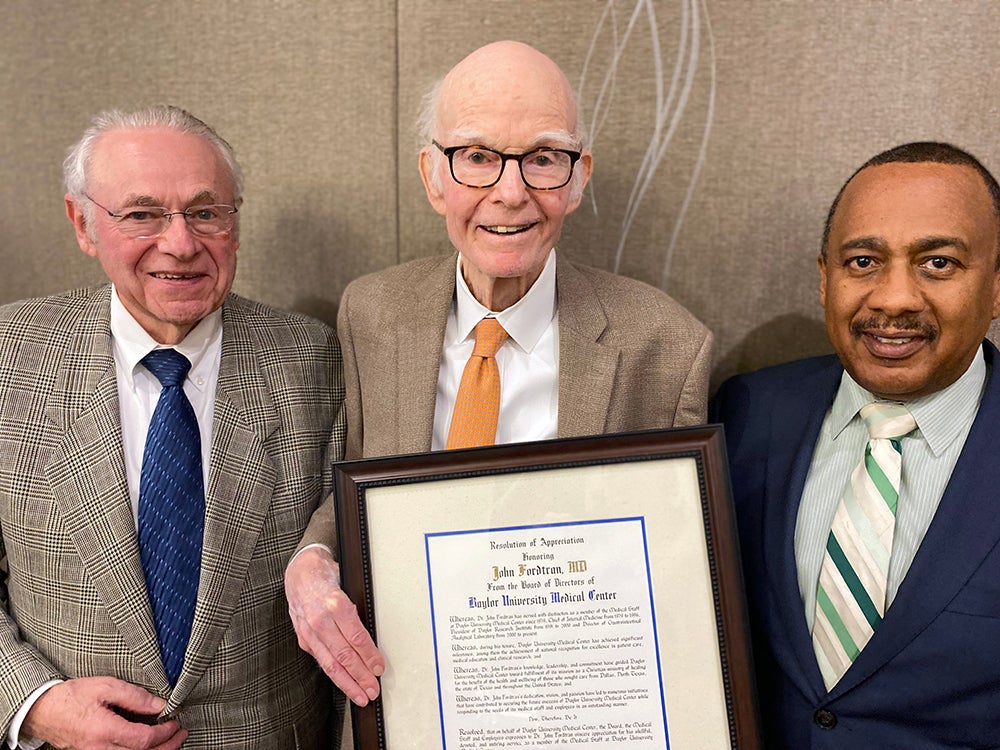
Long before today’s digital research era, the late John S. Fordtran, MD, helped define Baylor Scott & White’s reputation for patient-centered discovery. Recognized as the pre-eminent gastroenterologist of the 20th century, his work helped transform how physicians understand and treat digestive diseases.
His research led to innovations still used around the world, including:
- Oral rehydration solutions that have saved millions of lives
- Modern colonoscopy preparation methods
- The first randomized controlled studies showing that antacids can heal ulcers
When Dr. Fordtran joined Baylor University Medical Center in 1979 as chair of internal medicine, he brought a crucial conviction: that the best research studies human physiology in patients, not only in the lab. His patient-first approach shifted BSW’s research culture toward clinical investigation that directly improves care—a philosophy that continues in today’s Multi-Hub model.
Cardiovascular innovation: Improving heart procedures
More than a million cardiac catheterization procedures are performed each year in the United States. For decades, catheters were inserted through the groin, then later through the wrist. Today, research supported by the Gupta Family Foundation is helping patients gain another option—through the hand.
Led by Karim Al-Azizi, MD, an interventional cardiologist at Baylor Scott & White, the Distal versus Proximal Radial Artery Access (DIPRA) study is the first in the country to compare the traditional wrist access point with a newer distal radial entry near the base of the thumb. The same artery is used—just at a different location—but the implications are significant.
The study found that distal radial access is just as safe, does not increase bleeding and does not affect hand function. It may also lower the risk of radial artery occlusion, a potential long-term complication of wrist access. The approach is common in Europe but still emerging in the U.S., and Baylor Scott & White is helping lead the way.

For trial participant Kent Prince (left), the benefit was immediate.
“It’s exciting to see research focused on helping patients recover faster,” he said. “Being able to get back to your normal activity sooner – even work – makes a real difference in your long-term heart health and overall wellbeing.”
These findings are already helping shape national practice and expand options for patients needing catheterization procedures.