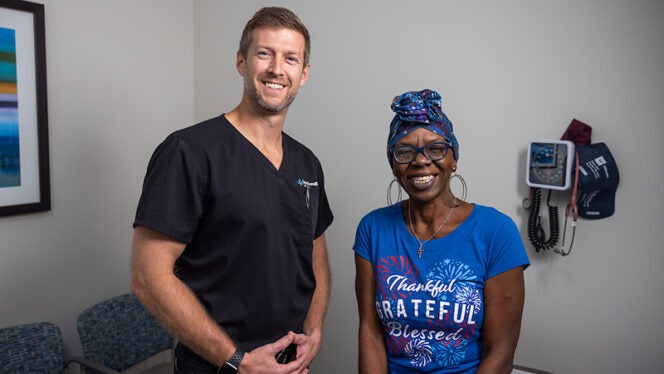







Baylor Scott & White Health and Geode have teamed up to offer Texans unprecedented access to high-quality mental healthcare.
For many Texans, asking for help with their mental health is only the first hurdle. The next one can be harder: finding care that is available, affordable and close enough to reach.
That challenge shows up nationwide primary care offices every day. A patient may come in for a routine physical, a chronic condition, trouble sleeping or medication concerns. During the visit, something deeper surfaces. Stress that is making a health condition harder to manage. A teenager struggling with depression. An older adult struggling with isolation. A patient ready to ask for help, but unsure where to go next.
For physicians, those conversations can be delicate.
“Opening up about mental health issues is hard, and the thought of a stressful process to get in to see a therapist or psychiatrist may discourage someone from seeking help again or going to appointments,” said Daeija Lewis, MD, a family medicine physician on the medical staff at Baylor Scott & White Health.
When a patient is ready to talk, delays and uncertainty can quickly become barriers.
In some cases, patients face months-long waits to see a mental health provider. Others struggle to find someone who accepts their insurance. Many simply don’t know where to start. Even when physicians can identify the need, finding the right next step isn’t always easy.
A growing need across Texas and the nation
The demand for behavioral health services continues to outpace available resources.
According to recent data, Texas has the lowest ratio of mental health providers in the country, with one provider for every 690 residents. Forty-one percent of Texans report they or someone they love needs mental health support but cannot access it. The state also ranks last in the nation for youth mental health access, with 10 psychiatrists per 100,000 youth.
Mental health concerns can influence how people manage chronic disease, follow treatment plans, attend appointments, succeed at work, care for family members and maintain relationships. For many patients, mental health is deeply connected to their overall health and well-being.
Yet historically, behavioral health services have often existed separately from the rest of the healthcare system, creating barriers for patients trying to navigate care.
Choosing the right partner
As Baylor Scott & White continues to evolve its strategy around creating a more connected, consumer-centered healthcare experience, leaders began taking a closer look at access to mental health care.

“We knew [Mental Healthcare] was a significant need in the communities we serve, and we knew we needed a better way to help patients get care.”
-Mike Sanborn, chief growth officer for Baylor Scott & White Health
For Mike and other system leaders, the challenge represented an opportunity to rethink how healthcare organizations address behavioral health altogether.
Baylor Scott & White explored multiple approaches to expanding behavioral health services, including building new programs internally, acquiring existing organizations and pursuing strategic partnerships.
Leaders ultimately chose Geode Health, a provider of outpatient behavioral health services, because of its demonstrated clinical outcomes, team-based care model and ability to expand access quickly across Texas.
The new joint venture is majority-owned by Baylor Scott & White, allowing the health system to invest in growth while leveraging Geode’s behavioral health expertise.
“We were looking for a partner that could help us move quickly, expand access and deliver high -quality outcomes for patients,” Mike said.
The partnership includes a substantial investment to grow behavioral health services across Baylor Scott & White markets and integrate those services into the broader Baylor Scott & White ecosystem.
Today, patients can find behavioral health services through the MyBSWHealth app, Baylor Scott & White physicians and care teams, or directly through Geode locations.
Creating a clear path to care

“When my patients ask for help, I can confidently say we have a system in place that works and is quick and easy to get into. It makes me feel like I’m actually helping them with their next step, rather than putting it in their hands to figure it out.”
Dr. Daeja Lewis, Baylor Scott & White Health
Referrals can be placed directly through Epic, the electronic health record platform used across Baylor Scott & White. Once the referral is submitted, Geode helps connect patients to care and schedule appointments.
Because Geode is integrated with Epic, Dr. Lewis can follow along with details of a patient’s care and understand what the primary care team may need to continue addressing.
The response has been immediate. In less than a year, Baylor Scott & White providers have made more than 27,000 referrals to Geode, about 150 referrals a day.
“That tells you how great the need was,” Mike said. “These are patients our physicians were already seeing, and many of them needed behavioral health support as part of their overall care.”
A different model of care
The Geode model is designed around team-based, psychiatrist-led care. Patients typically begin with a psychiatrist, who helps assess their needs and develop a personalized treatment plan. From there, care may include therapists, psychologists, nurse practitioners, physician assistants or other behavioral health specialists.
This approach allows patients to receive the level of support that best matches their needs while maintaining psychiatric expertise at the center of care. Services are available for children, adolescents and adults and include psychiatry, psychotherapy, medication management, therapy and specialized treatments, such as transcranial magnetic stimulation (TMS) and Spravato.
The model also addresses two of the most common barriers to care: affordability and access.
Unlike many behavioral health practices that operate primarily on a cash-pay basis, Geode accepts most major insurance plans, including Medicare.
“Affordability was important to us,” Mike said. “If we were going to help expand access, we needed a model that worked for more patients.”
Patients can access care through in-person and virtual appointments, and same-week appointments are often available, even as referrals have grown.
Dr. Lewis said several patients have told her they were able to schedule quickly, and many have appreciated the option of virtual visits, especially those balancing school or work.
Further, this patient-centric, team-based approach is attractive to those that deliver mental healthcare. The model has allowed Geode to more than double the number of psychiatrists, providers and therapists available.
Expanding access across Texas
The partnership began with 13 Texas locations. Today, Geode operates 21 locations in Dallas-Fort Worth, Austin, Waco, College Station and Houston, with 14 additional sites planned in 2026.
This growth is being guided by patient demand and community need. Leaders analyze referral patterns and place new locations where they can have the greatest impact. In Dallas, for example, a new location opened near Baylor University Medical Center to better serve patients in the urban core. The clinic quickly became one of the busiest locations in the network.
Over the next several years, Baylor Scott & White and Geode aim to expand to as many as 100 locations, bringing behavioral health services closer to more Texans.
Early results and a broader vision
Early results are encouraging. Among Baylor Scott & White patients receiving care through Geode, 78% report measurable clinical improvement within five months.
While these outcomes are important, Baylor Scott & White leaders view the partnership as part of something larger.
Through its partnership with Geode, Baylor Scott & White is working to create a more connected, accessible model of behavioral health care—one that helps ensure patients can receive support when and where they need it most.
As Baylor Scott & White continues this work, the Foundation is exploring how philanthropy may help expand access to mental healthcare for more patients and communities. To learn more, please contact Christina Goodman at 214.820.4408 or Christina.Goodman@BSWHealth.org.