



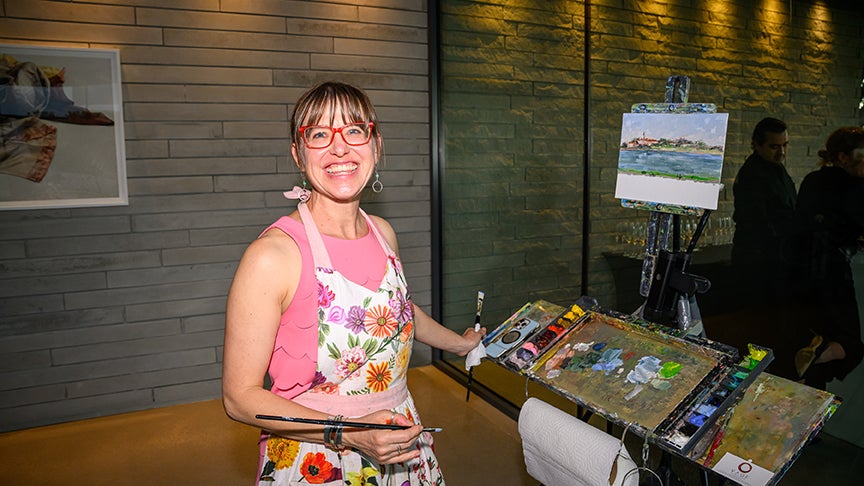
Featured photo, above: Juliana Crownover, artist in residence for Arts in Medicine at Baylor University Medical center, paints a landscape at a recent event marking the program’s 10 year anniversary.
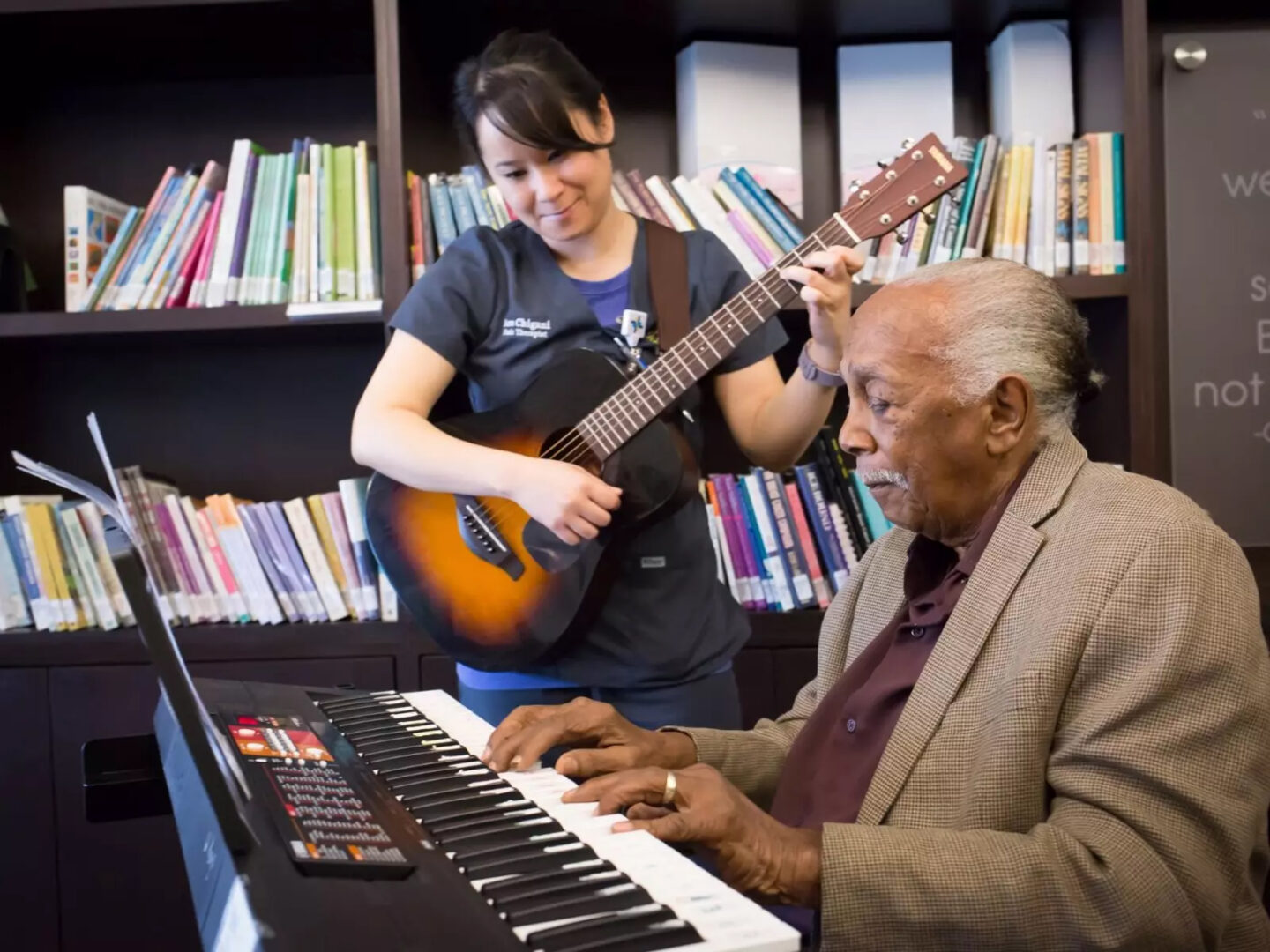
Arts in Medicine often shows up in small, unexpected ways at the bedside: a musician offering to play, an artist inviting someone to create, a moment that briefly shifts the pace of care.
For Bonnie Pitman, moments like these have been part of her own experience as a patient at Baylor Scott & White Health.
“Sometimes you’re alone in a hospital room, and then the door opens and someone says, ‘May I play music for you?’…and you just start to cry,” Bonnie said.
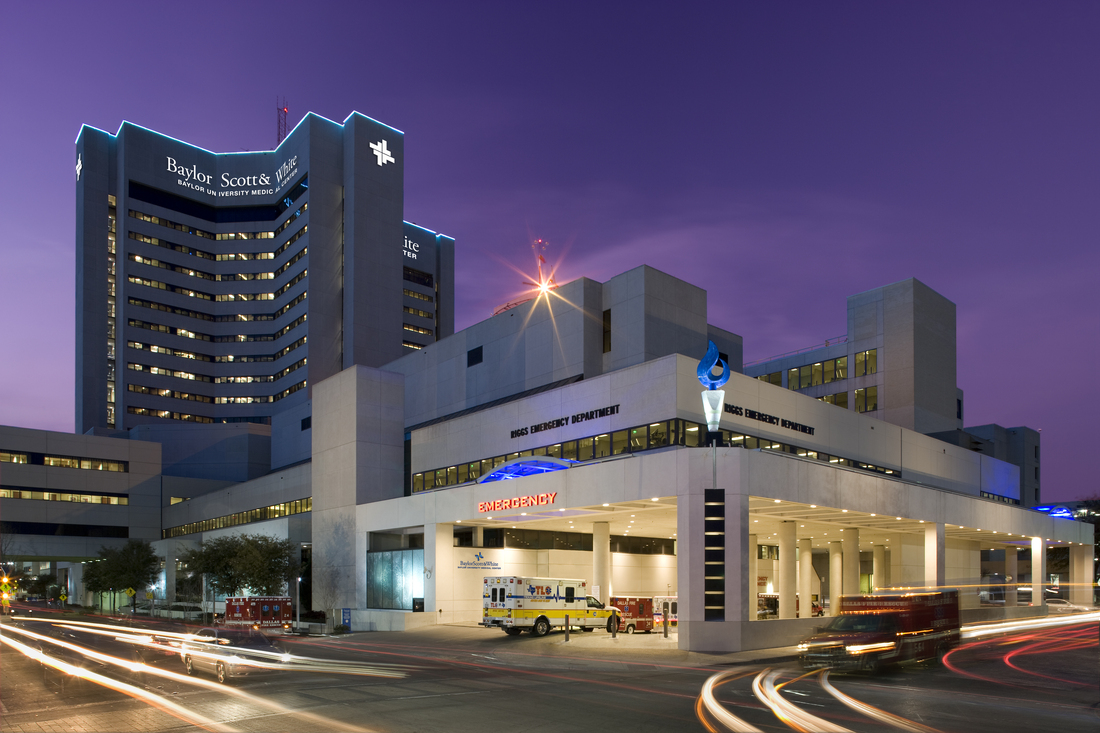
A longtime arts leader and grateful patient, Bonnie shared how illness changed her life and how Arts in Medicine at Baylor University Medical Center (BUMC) helps restore something just as essential as clinical care: connection — dignity and a sense of self.
An evening full of meaning
On a spring evening in East Dallas, nearly 100 supporters gathered in a home overlooking White Rock Lake to celebrate the 10th anniversary of Arts in Medicine.
Hosted by Mickie and Jeff Bragalone, the setting reflected the spirit of the program itself—intimate, creative and rooted in connection.
A painter worked quietly in the background. Music drifted through the home. Guests lingered in conversation, moving from room to room, pausing to watch artists at work.
There was no rush, just space to connect, reflect and feel the quiet impact of the work being celebrated.
More than numbers: Moments that matter
Over the past decade, Arts in Medicine has grown into an integral part of care at BUMC — made possible entirely through philanthropy.
The numbers are meaningful:
- Nearly 10,000 individuals have visited the Open Art Studio
- More than 3,500 bedside art therapy sessions have been provided
- Over 9,000 music therapy sessions have supported patients
- More than 2,500 NICU sessions have reached the smallest patients
- Nearly 50,000 music practitioner encounters have brought live music directly to the bedside
- More than 10,000 hours of music and art have filled common spaces
But as Susan Sayles, practice administrator for Arts in Medicine, shared with guests, the true impact cannot be captured in numbers alone.
These are moments when a patient becomes more than a diagnosis. Moments when a family finds comfort. Moments when a caregiver pauses, breathes and reconnects.
“It’s about allowing someone to be a whole, creative individual,” Susan said. “Not just a patient.”
The power of being seen
For Bonnie, those moments were transformative.
What began years ago with simple art carts in clinical spaces has grown into a robust program that brings artists, musicians and therapists directly into the care environment.
But the impact, she explained, reaches far beyond the patient.
Music played at the bedside doesn’t stay there. It drifts into hallways, drawing in nurses, physicians and staff—creating shared moments of calm and connection in the midst of demanding days.
“The program helps the patient, the patient’s family and also all of the practitioners,” Bonnie said. “It gives them a chance to reduce stress, to connect and to experience something that is not medical.”
She described how, even now, during hospital stays, she creates entire “journeys” from her room — inviting friends to send music, images and poetry from places like Venice or Paris, transforming a clinical space into something imaginative and alive.
It is a reminder that healing is not only physical. It is emotional. It is creative. It is deeply human.
A program built and sustained by generosity
As the evening drew to a close, Baylor Scott & White Dallas Foundation President Christina Goodman reflected on what has made the program possible — and what continues to sustain it.
“This program exists because people believed care could look different,” she said. “Yes, the numbers matter. But what Bonnie’s story shows us is something deeper — how this work helps people feel seen and heard.”
Arts in Medicine is 100% supported by philanthropy. From its earliest days, it has been shaped by donors who understood that healing extends beyond medicine alone and who chose to invest in something both innovative and profoundly personal.
Thanks to that generosity, the program has not only grown — it has become embedded in how care is delivered across Baylor Scott & White.
Looking ahead
If the first decade of Arts in Medicine has proven anything, it’s that the need for this kind of care continues to grow.
What began as a small, thoughtful idea has become an essential part of the care experience — and the opportunity now is to expand that reach even further. With continued philanthropic support, Arts in Medicine will grow to meet that demand, bringing music, art and human connection to more patient rooms, more families and more care teams across Baylor Scott & White.
Because sometimes, in the most difficult moments, healing begins in the simplest ways — a gentle knock on the door, and a quiet question: “Would you like to hear a song?”
Help sustain Arts in Medicine at Baylor University Medical Center.